
Thursday, 27 March 2014
Frankfurt Bahnhofsviertel: 7 Pilot investigations: (5 Elbestrasse Taunusstrasse)
1 https://www.youtube.com/watch?v=b7W235_AuoQ
2 https://www.youtube.com/watch?v=vVyuQT6wRX8
3 https://www.youtube.com/watch?v=o7pbwfWv5nM
4 https://www.youtube.com/watch?v=gtP9afpA1o0
5 https://www.youtube.com/watch?v=qN1ES2n8j-k
6 https://www.youtube.com/watch?v=vzObAsQOyK8
7 https://www.youtube.com/watch?v=KOCoPmiGHfs

Tuesday, 1 October 2013

Streets cf. Roads
"We desperately need a more sophisticated understanding of the difference between a road and a street. Our DOTs (departments of transport) are damaging our cities, wasting money they don't have pursuing antiquated goals using yesterday's procedures. We can do more with less if we adopt a strong towns approach."
http://www.strongtowns.org/journal/2013/8/26/roads-and-streets-in-st-peter.html#.UksH1tJNHkU
http://www.strongtowns.org/journal/2013/8/26/roads-and-streets-in-st-peter.html#.UksH1tJNHkU
Friday, 25 January 2013

Wednesday, 2 January 2013


Monday, 17 September 2012
themes
Occupying Streets - Key Research analysis themes, September 2012
grounded
clutter and decluttering ----- ent-rümpel-ung
disenfranchisement and enfranchisement ----- bürger-berechtigung bzw entrechtigung
accessibility ----- zugänglichkeit
active frontages ----- sozial aktiv Fassade
adult entertainment ----- erwachsenenunterhaltung bzw rotlicht bzw milieu
motor vehicle (car)-centric planning ----- autogerechtes (motor fahrzeug) stadtplanung
character of place ----- ortscharakter
collaboration ----- zusammenarbeit
conflict ----- konflikt
deemed to comply with planning ----- planungentsprechend
design ----- design gestaltung
distinctiveness of place ----- ortsbesonderheiten
diversity ----- vielfalt
drug addict, drinker ----- drogensüchtige mensch
emotion love - hate ----- liebe hass, mag night mag, unangenehm / angenehm
(or milder like / dislike, agreeable / disagreeable)
energy ----- energie
gender male-female (masculine / feminine / gay etc) ----- mannlich - weiblich - schwühl
greening ----- begrünung
mode of transport ----- verkehrsart
noise - sound ----- geraüsch / klang
pavement-parking ----- gehsteige / gehwege / autoabstellplatz / parkplatz
price ----- preis
professional silos ----- expertentrennung
recognise others ----- erkennung anderen
safety and health ----- sicherheit / gesundheit
time - day - night - year - season ----- zeit - tag - nacht - jahreszeit
transitional place - node ----- übergangsort / knoten
trees ----- bäume
grounded
clutter and decluttering ----- ent-rümpel-ung
disenfranchisement and enfranchisement ----- bürger-berechtigung bzw entrechtigung
accessibility ----- zugänglichkeit
active frontages ----- sozial aktiv Fassade
adult entertainment ----- erwachsenenunterhaltung bzw rotlicht bzw milieu
motor vehicle (car)-centric planning ----- autogerechtes (motor fahrzeug) stadtplanung
character of place ----- ortscharakter
collaboration ----- zusammenarbeit
conflict ----- konflikt
deemed to comply with planning ----- planungentsprechend
design ----- design gestaltung
distinctiveness of place ----- ortsbesonderheiten
diversity ----- vielfalt
drug addict, drinker ----- drogensüchtige mensch
emotion love - hate ----- liebe hass, mag night mag, unangenehm / angenehm
(or milder like / dislike, agreeable / disagreeable)
energy ----- energie
gender male-female (masculine / feminine / gay etc) ----- mannlich - weiblich - schwühl
greening ----- begrünung
mode of transport ----- verkehrsart
noise - sound ----- geraüsch / klang
pavement-parking ----- gehsteige / gehwege / autoabstellplatz / parkplatz
price ----- preis
professional silos ----- expertentrennung
recognise others ----- erkennung anderen
safety and health ----- sicherheit / gesundheit
time - day - night - year - season ----- zeit - tag - nacht - jahreszeit
transitional place - node ----- übergangsort / knoten
trees ----- bäume
Friday, 27 July 2012
Liveable London Streets
"Jon Snow sees Olympic Lanes as 'hope for liveable cities'... " a provocative and ironic headline from Mark Sutton in BikeBiz on 26 July
Segregation - the post-WW2 highway engineering technique of dividing road space between users - has apparently made London streets temporarily less congested and more inviting - but for the twenty-first century city, the 'architecture' of occupying street must evolve with a new urban environment. Cyclists were agreeing with Snow on twitter that (ironically) the ZIL lanes had made Whitehall more pleasant for cycling.
Segregated cycle infrastructure, in the form of dedicated lanes, even re-purposed olympic (VIP limousine) lanes may be one way to make a visible political gesture in support of cycling. We have seen this in the form of the blue 'Boris' lanes - where there have also been cycle fatalities. I have seen an example on Peace Avenue, the main east-west traffic artery in the rapidly-developing Mongolian capital Ulaanbaatar. There, a short section of segregated green-painted cycle lane was installed to promote a local political campaign to modernise and globalise (in appearance at least) a city full of jeeps and coal-fired power stations. These lanes have done little for pedestrian environments, for aesthetic qualities of streets, or for any holistic idea of liveable streets. In London, 'Going Dutch' as the London Cycle Campaign is branded, will require more than road-space reallocation, but also changes in head-space of all street users. In inner-city London, there is currently too little understanding distinctions between roads and streets in the public realm.
In the case of London, the task of developing more liveable city streets might be helped somewhat by maintaining VIP lanes as a legacy for cycling, and by continuing to deter motorists from entering London. The cause will be helped somewhat by the prevalence (in both road space and head space) of urban cycling advocates like Jon Snow, my boss, Mark Sutton (and me - MAMIL tendency noted). However, streets will also have to be reclaimed by citizens as part of the public realm, beyond 20th century transport engineering (TfL). The physical environment of London streets needs to be recolonised and designed by, with and for people who live and work in them. GC
Segregation - the post-WW2 highway engineering technique of dividing road space between users - has apparently made London streets temporarily less congested and more inviting - but for the twenty-first century city, the 'architecture' of occupying street must evolve with a new urban environment. Cyclists were agreeing with Snow on twitter that (ironically) the ZIL lanes had made Whitehall more pleasant for cycling.
Segregated cycle infrastructure, in the form of dedicated lanes, even re-purposed olympic (VIP limousine) lanes may be one way to make a visible political gesture in support of cycling. We have seen this in the form of the blue 'Boris' lanes - where there have also been cycle fatalities. I have seen an example on Peace Avenue, the main east-west traffic artery in the rapidly-developing Mongolian capital Ulaanbaatar. There, a short section of segregated green-painted cycle lane was installed to promote a local political campaign to modernise and globalise (in appearance at least) a city full of jeeps and coal-fired power stations. These lanes have done little for pedestrian environments, for aesthetic qualities of streets, or for any holistic idea of liveable streets. In London, 'Going Dutch' as the London Cycle Campaign is branded, will require more than road-space reallocation, but also changes in head-space of all street users. In inner-city London, there is currently too little understanding distinctions between roads and streets in the public realm.
In the case of London, the task of developing more liveable city streets might be helped somewhat by maintaining VIP lanes as a legacy for cycling, and by continuing to deter motorists from entering London. The cause will be helped somewhat by the prevalence (in both road space and head space) of urban cycling advocates like Jon Snow, my boss, Mark Sutton (and me - MAMIL tendency noted). However, streets will also have to be reclaimed by citizens as part of the public realm, beyond 20th century transport engineering (TfL). The physical environment of London streets needs to be recolonised and designed by, with and for people who live and work in them. GC
Friday, 6 July 2012
Caledonian Road & Niddastrasse: Songs / Themes
Reviewing more than forty interviews I conducted, I composed twenty main themes.
Songs of Niddastrasse / Bahnhofsviertel Frankfurt
Hotel guests from China visiting the Frankfurt book fair don't understand the situation with Frankfurt drug-users in the street (F14)
2. contrast of different types of people
"that place makes great dumplings" two architects, also "we saw someone ‘painting a building with their with fingernails’ " i.e. drug user scratching wall in the street (F18)
3. safety and health in the street and behind the building fronts
In Niddastrasse I conduct industrial health and safety checks in offices and workplaces here, DBSV calls for provision for blind people, kerbs, crossings (F4)
4. active frontages
I've walked Niddastrasse for twenty years. The street is very narrow at the Taunusanlage end, has inactive frontages (F21) I didn't notice the gambling hall (F14)
5. greening the street
"Niddastrasse needs a few more trees" cafe waiter at Luna Park talking with two architects, also graphics office also Dona Carmen F21
6. ideal future of Niddastrasse
Church minister imagines Niddastrasse as heaven: "no drugs, no prostitution, the born-again into God's Kingdom" F5
7. decluttering
nobody has mentioned obsolete duplicated or unnecessary signage or street furniture
8. habitable street space
Furriers morning coffee meetings at benches outside cafe Luna Park, birthday party. Restaurant tables on Karlsplatz
9. vehicle traffic flow
vehicle access is important. Parking fr 25h Hotel. Narrow end, street parking. The area has a high level of public transport accessibility (F19)
10. trees
lack of active frontages F21
Songs of Caledonian Road / King’s Cross London
1. two way and one way streets
Safety on the traffic gyratory: cyclist and heritage activist (L14), advertising exec (L19, L13) Shared space difficult to use for blind people and guide dogs, tactiles are ambiguous (L3)
2. attractive old buildings and scale
nice buildings on lower Caledonian Rd - advertising exec (L19) even in cold weather and rain
3. public realm design
public realm risk and safety (L1) Huxf (L2) Russell spaceshaper process games to collaborate CN (L10)
4. pedestrian safety
safe, viable, vital and attractive streets lighting near buses L7 Sanaz
5. cycling environment
King's Cross to Marylebone by bicycle - less Stop-Start than Fft, non-signal controlled junctions left traffic, shop facades (L8) cycle activists “Bikes Alive” K (L17, L19, L16) nature, (L15, L14) LCC
6. mix of uses
Green Sky thinking L6, north section improvements Vaultex planter boxes, Cine club and Mosque
7. decluttering
Difficult to get agencies together to deduplicate signage and unnecessary street furniture (L12)
8. Distinctive Independent Shops
Shopkeeper says Tesco chain store has benefited small independent Italian Continental Delicatessen (L13)
9. Vital and distinctive area
Visitors Italy (L18) Belgium (L11), optimistic about the future of the area, London vitality
10. Gyratory removal
return to two-way traffic will require removal of some buildings (L20)
draft 6.7.12
Thursday, 14 June 2012
Hotel, Niddastrasse
(Excerpt) Januar 2012, Frankfurt
Wollen Sie dieses Hotel einmal kurz beschreiben?
(Would you like to briefly describe this Hotel?)
(Would you like to briefly describe this Hotel?)
Das ist ein chinesisches Hotel mit fast 75 Zimmern – das war es eigentlich.
(It is a Chinese Hotel, almost 75 rooms, that's it really)
Ok. Wir befinden uns im mittleren Teil der Niddastraße, unten Richtung Osten ist eher ein Bankenviertel mit Hochhäusern, nach Westen ist der Bahnhof. Da gibt es auch Designhotels. Dieser mittlere Teil ist zwischen Karlsplatz und Elbestraße. Wissen Sie, was für andere Nutzungen es in dieser Straße gibt – Hotels, Läden, Geschäfte?
(OK. We are in the middle part of the Niddastrasse, here to the east a banking district, with highrise, to the west, the Railway Station. There are designer hotels there. This section is between Karlsplatz and Elbestrasse. Do you know what other uses exist in the street - hotels, shops, businesses?)
(schweigt) silence
Sie wissen, dass es andere Hotels gibt?
(You know about the other hotels?)
Ja, oben das Elbehotel...
(Yes, up there the Elbe Hotel)
Und nebenan ist ein Spielcasino...
(And adjacent is a Betting Shop-casino)
Ja, ja!
(Oh yes!)
Gibt es etwas an dieser Straße, das Sie mögen oder nicht mögen?
(Is there something about this street, which you like or dislike?)
Was ich nicht mag ist klar – diese Seite und diese Leute.
(What I dislike is clear - this side and these people)
Welche Leute sind das?
(Which people?)
Die Leute nehmen Drogen, und jeden Tag am Nachmittag ab 17 Uhr treffen die sich alle hier.
(These people take drugs, and every afternoon at 5pm, they all meet here)
Und machen sie Ihnen Probleme?
(And do they cause you any trouble?)
Eigentlich nicht. Aber unsere Gäste sind meistens Ausländer, die kennen nicht so viel von
Deutschland. Und diese Straße und die Leute sehen schlimm aus.
(Not really. But our guests are mostly foreigners, they don't know much about Germany. And this street and these people look bad.)

Thursday, 19 April 2012
Petition and Open Letter to the City - Frankfurt
A group of Frankfurt Station-Quarter Residents in March wrote an open letter about their dissatisfaction with the local 'drug problematic' and its impact on living in the area. The Railway Quarter in the centre of Frankfurt (Bahnhofsviertel) is (in)famous, not only for its well-organised Red Light Area, but for its long standing drug strategy, called the Frankfurt Model (Frankfurter Weg), which has been developed to tackle the regional problems of drug abuse.
The letter-petition from Residents, addressed to the Lord Mayoress, to the election candidates for Lord Mayor, and to all participating institutions of the city's monthly Monday Panel (Montagsrunde) is also published on the blog Bahnhofsviertel Frankfurt. The letter stated that the situation for residents had become 'unbearable' and cited three recent conflicts on the street between residents and drug-users.
According to the same blog, there has been a reassuring response and there has been some improvement since March, and there will be a workshop (Werkstatt Bahnhofsviertel) about the issues, to be held on 7 May.
OFFENER BRIEF AN:
– Die Oberbürgermeisterin der Stadt Frankfurt –
– Die Kandidaten der Oberbürgermeisterwahl –
– Alle teilnehmenden Institutionen der „Montagsrunde“ –
monatlich tagendes Gremium zur Drogenproblematik Frankfurt bestehend aus
Dezernat X (Umwelt, Gesundheit und Personal),
Drogenreferat,
Staatliches Schulamt,
Amt für Gesundheit,
Polizeipräsidium Frankfurt,
Jugend- und Sozialamt,
Ordnungsamt,
Geschäftsstelle des Präventionsrates,
Staatsanwaltschaft,
Vertreter der Drogenhilfe
Saturday, 17 March 2012

These routes provide vital arteries for London’s commercial traffic, in addition to their place, function and importance for pedestrians and cyclists. In considering lower speed limits on such routes, therefore, the potential benefits in terms of both safety and liveability of our town centres needs to be taken into consideration alongside the important transport functions these routes perform..."
In a recent letter from TfL Streets, this statement suggests that, in the difficult business of balancing place and movement, the "reality" of managing TRLN roads (Transport for London Road Network - the strategic arterial routes) is complex, implying that it may be difficult to change.
Is the "commercial traffic" transport function and the average speed of "commercial traffic" (higher that 20mph? - usually default of 30mph in built-up areas) more important than walkability and liveability of high streets? For what reason does this (historical, commercial) motorised movement take precedence over place in TfL Streets approach?
The TfL Streets response above does not answer my original question about the effect of 20mph limits on journey time reliability (as part of the smoothing traffic flow agenda) on TRLN roads. I have followed my question with another enquiry about TfL Streets' methodology for balancing movement and place (see Manual for Streets MfS).
Yesterday at New London Architecture gallery, Sir Peter Rogers from the Mayor's office talked about regenerating 90 outer London High Streets where people live and work. Case studies were presented from Willesden Green, Streatham / West Norwood, and Brentford. Transport - and TfL Streets management of high streets - were hardly mentioned until the question was raised at the end. Mark Brearley, head of Design for London, cautiously broached the topic of the ongoing problem of "recalibrating" the motorised traffic balance with place quality in the public realm.
Thursday, 1 March 2012
Roads and Streets in London - and King's Cross Square
I enquired about the public realm function of central London TfL roads, considering that the professional highway planning guide, the Manual for Streets (2010) calls roads with an important public realm function - ie. most in central London - 'streets' for planning purposes.
Transport for London gave me this advice:
"The guidance published by TfL on streetscape principles (“Streetscape Guidance 2009: A guide to better London streets” , link) applies to any public highway managed by TfL (TfL red routes such as Euston Road) and it therefore goes beyond the traditional classification between roads and streets.
Documents published by London Borough of Camden and the Mayor of London (Local Development Framework, Unitary Development Plan, London Borough of Islington and Mayor’s London Plan) guide the development of King's Cross Central including King’s Cross square. I would advise you to contact London Borough of Camden to find out about specific design principles applied when King’s Cross square planning application was reviewed."
I found that the Mayor of London in 2009 included King's Cross Square as one of "London's Great Spaces" but at that stage the street (A503) was not part of the square, nor was this clear in Camden's LDF, its UDP or its SPD. The Planning Applications (2010/3152/P, 2011/0019/P, 2011/1961/P, and 2011/4782/P) for King's Cross Square (discussed in the news) are on Camden's planning applications website.
Monday, 27 February 2012
Bus Lane (Caledonian Road 120226 00.45)
Returning from Covent Garden after midnight last Saturday by London hire cycle, I approached King's Cross to find all the parking stands fully occupied at hire stations in St Chad's Street, Belgrove Street and Ampton Street, and irritated, I made my way north to Killick Street, off Caledonian Road. As expected, the Killick street hire station was almost empty, so I parked and walked south on Caledonian Road at about 12.45am.
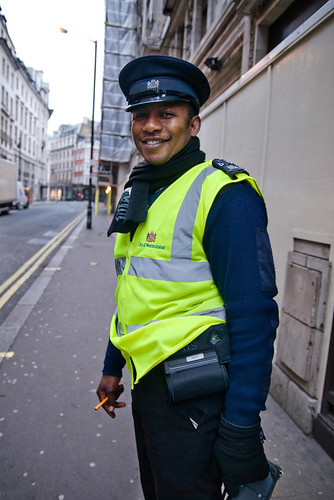
There was little activity in the street besides motor traffic around Wharfdale Road, but there were increasing numbers of revellers standing in the street as I passed Simmons and Keystone Crescent opposite the Tesco on the corner of Caledonia Street. There was a row of cars parked along the east side of Caledonian Road, almost to the junction of Pentonville Road, and there were many people in the street in front of the fast food shop and the Burrito place. There seemed to be activity around an event at Scala on the Kings Cross Bridge. In front of the line of parked BMWs and Mercedes saloons, a group of young Asian men with their arms around one another was standing looking quizzically at a tall black Islington parking warden with long curly hair, as she held up her compact digital camera to photograph the line of vehicles. "Bus Lane" she said to them.
 from 365 Londoners
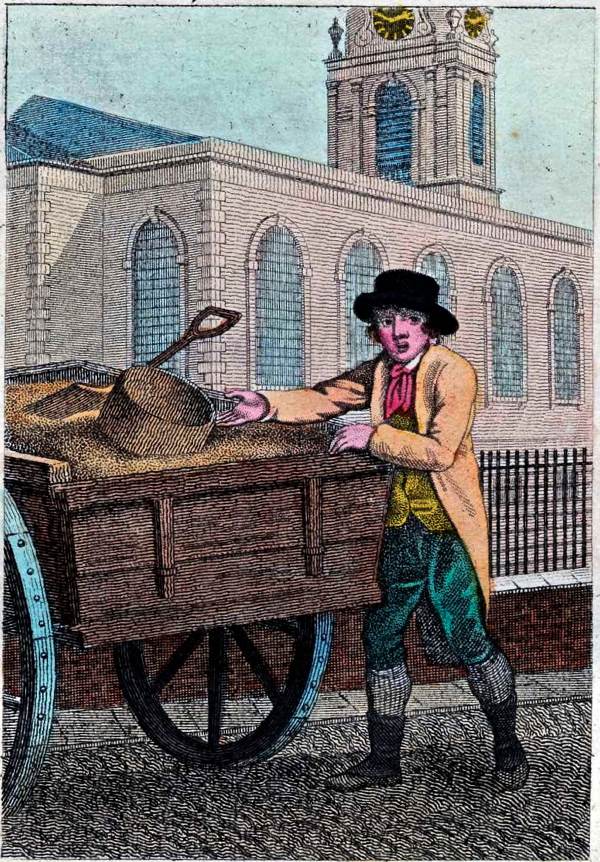
 from Wiliam Craig Marshall's 'Itinerant Traders' featured in Spitalfields Life
There was little activity in the street besides motor traffic around Wharfdale Road, but there were increasing numbers of revellers standing in the street as I passed Simmons and Keystone Crescent opposite the Tesco on the corner of Caledonia Street. There was a row of cars parked along the east side of Caledonian Road, almost to the junction of Pentonville Road, and there were many people in the street in front of the fast food shop and the Burrito place. There seemed to be activity around an event at Scala on the Kings Cross Bridge. In front of the line of parked BMWs and Mercedes saloons, a group of young Asian men with their arms around one another was standing looking quizzically at a tall black Islington parking warden with long curly hair, as she held up her compact digital camera to photograph the line of vehicles. "Bus Lane" she said to them.
Sunday, 26 February 2012
Exhibition Road Single surface (draft)
Street London inspection visit to Exhibition Road, a 'single surface scheme'
(Background on new Street Design - Angela Saini on Thinking Streets BBC January 2012)
Research recordings on-site 25 Feb 2012
(recording 120225.000)
[RBKC Highway Engineer]...and that was because of the [CB??] that we put the parking in the centre of the road as opposed to the kerbside as well.
The other thing was that we did reduce a number of the trees in Exhibition Road, and, again, we did actually cut some down, but we replaced more than we cut down, with semi-mature trees as well. All of the eight trees along there were all planted as part of the scheme, they came in from Holland and...
Traffic noise / about scooter / motorcycle parks (Question by Amanda UDG)
There aren't any on Exhibition Rd but there are some down in South Kensington
..and there's no cycle parks up this end...?
No, you are right and yes, that is something that we are reconsidering, actually..
Sorry!
Thats alright..
There is a huge number of resident car parks here with no cars on them - have you got an opportunity to re-visit that assessment and perhaps take some of them out?
Absolutely, yes, that's right.
And maybe put in more trees?
Trees are a little bit tricky actually, you've got services, and we've also got the tunnel and that sort of thing.
But, yes we are in a sort of assessment period, we only finished the scheme in October last year. So we'll wait and see how it beds in.
As I said before, vehicle speeds are a little higher than we'd ike especially on the section and particulaly in the evening as well. So we migfht have to come back and tweak to do that - maybe just enforcement..
and also some of the turning bans of the A4 are being ignored as well, so we have to look at that.
So the other thing is we are getting requests for more benches down the south section as well - coming out of the Tube station you've got nowhere to sit. There's a bit of resistance from residents there though, because they tend to attract undesirables as well...
1'55" author in informal discussion with Q*
[Practicing urban designer working at an architecture firm in London who studied at University of Queensland, Brisbane]
"We don't really do benches any more, do we?"
5'11''
Single surface is designed so pedestrians can cross but not walk up and down the carriageway
5'30"
People seems to be doing the same speed
5'55"
How do people know where to park and where not to, here? For example, is that guy there doing the right or wrong thing?
(recording 120225.001)
...background in planning or architecture? Architecture actually...
2'59"
There's no signage here saying no left turn.
[Engineer]
Back there at the traffic lights there is, no left turn on the actual traffic signals there. We are looking at getting some road markings put in and possibly even building up the kerb..
Is that what all that temporary stuff is for? (cnr Cromwell & Exhib Road)
Yes, its taking a while for people to get used to it.
3'20"
This also marks the point where the character of the road changes - from this point north its more to do with museums - from this point south you've got lots of cafes and restaurants and shops. We are in the process of issuing tables and chairs licences to allow people to use the space in a better way kind of thing.
These things you see here sticking out of the road, they are called lanterns, and what they do is provide natural light to the tunnel, pedestrian tunnel underneath, and as part of the first stage of the scheme we actually removed them and refurbished the. They actually fell apart - they have been there since 1850, so it took a while to refurbish them.
Also the street lighting's changed here its more in proportion with the scale of the buildings and that sort of thing as opposed to these big masts
... they were expensive, they were £23000 each those lamp columns and the foundation is a huge great block of concrete, which was the first operation we did, to make sure they were all in line
As big as a tree root-bulb?
Bigger than that, they are about 2metres by 2metres, and we had to allow services to go through them.
5'22"
Basements were the biggest challenge on this job
if you go anywhere near them they start leaking water, then you've got disputes with the owners...
6'05"
Are the lights on all night?
Yes I believe they are.
Projectors cast light on the whole width of the road
So it is a shared lighting scheme?
It is.
7'07"
We've only got minimal road markings
[Amanda UDG]
The banding seems to encourage (motorists to turn diagonally)
(recording 120225.002)
We are on the corner of Exhibition centre opposite the Ismaili Centre, Cromwell Road
[Engineer]
Well I tell you on the funding side of things
Kensington and Chealsea 13 million pounds
Mayor of London 14 million
Westminster 1 million
so they (Westminster) didn't put much money in at all
for some reason they insisted on a more conventional layout (north of Prince Consort Road)
Its more residential and
It could have been a square
Its a political thing
The residents don't any other users to come up
Is that because of litter?
They pay 2 million pounds a bedroom
The residents don't want the great unwashed hanging around
2'06"
[Engineer]
Forty percent of the road is in Westminster, actually, that's from Imperial College Road
So they did agree to this layout on part of the road...
(recording 120223.003)
[Engineer]
The York Stone is all recycled that you currently are standing on at the moment,
Again, before we did the work, there was guardrail running all over the place, lots of traffic lines, all that sort of thing, making it difficult for pedestrians to move around. Now we have taken all the guard railing out, we have got a straight across crossing. We have used york stone here, but we are getting people parking on it, which is why its a bit cracked in some places.
In conclusion, the borough policy is trying to use wherever possible high quality materials and reducing street clutter.
Thank you (applause)
We are Street London, the young Urban Design Network and the Urban Design Group
More tours coming up...
Click on picture below for Street Design photos including Exhibition Road

(Background on new Street Design - Angela Saini on Thinking Streets BBC January 2012)
Research recordings on-site 25 Feb 2012
(recording 120225.000)
[RBKC Highway Engineer]...and that was because of the [CB??] that we put the parking in the centre of the road as opposed to the kerbside as well.
The other thing was that we did reduce a number of the trees in Exhibition Road, and, again, we did actually cut some down, but we replaced more than we cut down, with semi-mature trees as well. All of the eight trees along there were all planted as part of the scheme, they came in from Holland and...
Traffic noise / about scooter / motorcycle parks (Question by Amanda UDG)
There aren't any on Exhibition Rd but there are some down in South Kensington
..and there's no cycle parks up this end...?
No, you are right and yes, that is something that we are reconsidering, actually..
Sorry!
Thats alright..
There is a huge number of resident car parks here with no cars on them - have you got an opportunity to re-visit that assessment and perhaps take some of them out?
Absolutely, yes, that's right.
And maybe put in more trees?
Trees are a little bit tricky actually, you've got services, and we've also got the tunnel and that sort of thing.
But, yes we are in a sort of assessment period, we only finished the scheme in October last year. So we'll wait and see how it beds in.
As I said before, vehicle speeds are a little higher than we'd ike especially on the section and particulaly in the evening as well. So we migfht have to come back and tweak to do that - maybe just enforcement..
and also some of the turning bans of the A4 are being ignored as well, so we have to look at that.
So the other thing is we are getting requests for more benches down the south section as well - coming out of the Tube station you've got nowhere to sit. There's a bit of resistance from residents there though, because they tend to attract undesirables as well...
1'55" author in informal discussion with Q*
[Practicing urban designer working at an architecture firm in London who studied at University of Queensland, Brisbane]
"We don't really do benches any more, do we?"
5'11''
Single surface is designed so pedestrians can cross but not walk up and down the carriageway
5'30"
People seems to be doing the same speed
5'55"
How do people know where to park and where not to, here? For example, is that guy there doing the right or wrong thing?
(recording 120225.001)
...background in planning or architecture? Architecture actually...
2'59"
There's no signage here saying no left turn.
[Engineer]
Back there at the traffic lights there is, no left turn on the actual traffic signals there. We are looking at getting some road markings put in and possibly even building up the kerb..
Is that what all that temporary stuff is for? (cnr Cromwell & Exhib Road)
Yes, its taking a while for people to get used to it.
3'20"
This also marks the point where the character of the road changes - from this point north its more to do with museums - from this point south you've got lots of cafes and restaurants and shops. We are in the process of issuing tables and chairs licences to allow people to use the space in a better way kind of thing.
These things you see here sticking out of the road, they are called lanterns, and what they do is provide natural light to the tunnel, pedestrian tunnel underneath, and as part of the first stage of the scheme we actually removed them and refurbished the. They actually fell apart - they have been there since 1850, so it took a while to refurbish them.
Also the street lighting's changed here its more in proportion with the scale of the buildings and that sort of thing as opposed to these big masts
... they were expensive, they were £23000 each those lamp columns and the foundation is a huge great block of concrete, which was the first operation we did, to make sure they were all in line
As big as a tree root-bulb?
Bigger than that, they are about 2metres by 2metres, and we had to allow services to go through them.
5'22"
Basements were the biggest challenge on this job
if you go anywhere near them they start leaking water, then you've got disputes with the owners...
6'05"
Are the lights on all night?
Yes I believe they are.
Projectors cast light on the whole width of the road
So it is a shared lighting scheme?
It is.
7'07"
We've only got minimal road markings
[Amanda UDG]
The banding seems to encourage (motorists to turn diagonally)
(recording 120225.002)
We are on the corner of Exhibition centre opposite the Ismaili Centre, Cromwell Road
[Engineer]
Well I tell you on the funding side of things
Kensington and Chealsea 13 million pounds
Mayor of London 14 million
Westminster 1 million
so they (Westminster) didn't put much money in at all
for some reason they insisted on a more conventional layout (north of Prince Consort Road)
Its more residential and
It could have been a square
Its a political thing
The residents don't any other users to come up
Is that because of litter?
They pay 2 million pounds a bedroom
The residents don't want the great unwashed hanging around
2'06"
[Engineer]
Forty percent of the road is in Westminster, actually, that's from Imperial College Road
So they did agree to this layout on part of the road...
(recording 120223.003)
[Engineer]
The York Stone is all recycled that you currently are standing on at the moment,
Again, before we did the work, there was guardrail running all over the place, lots of traffic lines, all that sort of thing, making it difficult for pedestrians to move around. Now we have taken all the guard railing out, we have got a straight across crossing. We have used york stone here, but we are getting people parking on it, which is why its a bit cracked in some places.
In conclusion, the borough policy is trying to use wherever possible high quality materials and reducing street clutter.
Thank you (applause)
We are Street London, the young Urban Design Network and the Urban Design Group
More tours coming up...
Click on picture below for Street Design photos including Exhibition Road
78 Caledonian Road
On a recent foray I had noticed a new barbershop at 78 Caledonian Road, opposite the Vegan shop (73) and a few doors north of the Mosque (70). Returning from grocery shopping in Islington, I stopped in to try it. A man was having his hair cut, and he and the barber were talking a language I could not recognise, and in which neither of the men seemed fully fluent. The barber seemed to work slowly and very carefully and the customer seemed very particular about his £4.99 cut, also after leaving the chair, standing at a mirror studying all the details of his haircut.

c.2008 (Google Streetview accessed 26 Feb 2012)
The shop had been open two weeks and the sign on the shopfront still said internet cafe - the letting agent's signboard was also still attached above the shopfront. In the window were some flyers advertising introductory offers, and there was a new-looking but inexpensively built set of three workstations with cabinets and mirrors. The packaging for three types of electric hairclippers were displayed on a high shelf alongside some computer-printed photographs of men modelling their haircuts, from the conservative businessman to the sculpted 'Turkish' style to the Anglo-student.
The barber Rajesh* explained in basic English that he was Nepali from Kathmandu, and had established this shop over the last fortnight with daily opening hours of 10.30am - 8pm. He explained that the previous customer was a Bengali with whom he had been speaking Urdu. The barber was a Hindi, the other man a Muslim, who appeared to me to have been testing the barber's abilities. I found Rajesh to be thorough and skilled. He enquired about my background and family and he explained that he had been living in East London for two years, while his wife and son were in Kathmandu.
There was a regular passing footfall on the pavement outside and occasional glances through the glass shopfront on this sunny Saturday. Outside the shop was a sandwichboard stand with four colour A4 flyers advertising the shop. I promised to mention the shop to friends and neighbours.

70 Caledonian Rd. c. August 2008 (Google Streetview accessed 26 Feb 2012)

c.2008 (Google Streetview accessed 26 Feb 2012)
The shop had been open two weeks and the sign on the shopfront still said internet cafe - the letting agent's signboard was also still attached above the shopfront. In the window were some flyers advertising introductory offers, and there was a new-looking but inexpensively built set of three workstations with cabinets and mirrors. The packaging for three types of electric hairclippers were displayed on a high shelf alongside some computer-printed photographs of men modelling their haircuts, from the conservative businessman to the sculpted 'Turkish' style to the Anglo-student.
The barber Rajesh* explained in basic English that he was Nepali from Kathmandu, and had established this shop over the last fortnight with daily opening hours of 10.30am - 8pm. He explained that the previous customer was a Bengali with whom he had been speaking Urdu. The barber was a Hindi, the other man a Muslim, who appeared to me to have been testing the barber's abilities. I found Rajesh to be thorough and skilled. He enquired about my background and family and he explained that he had been living in East London for two years, while his wife and son were in Kathmandu.
There was a regular passing footfall on the pavement outside and occasional glances through the glass shopfront on this sunny Saturday. Outside the shop was a sandwichboard stand with four colour A4 flyers advertising the shop. I promised to mention the shop to friends and neighbours.

70 Caledonian Rd. c. August 2008 (Google Streetview accessed 26 Feb 2012)
Wednesday, 15 February 2012

Tuesday, 7 February 2012
Shop in Niddastrasse - Frankfurt, Railway Station Area
What do you like and dislike about this street – Niddastrasse? Is it a nice street or not a nice street?
It is a nice street.
Why? What do you like about it? The sound, the plants, the people, the buildings ...
No, the people.
What sort of people do you meet in the street, in Niddastrasse?
Ah, the people is very nice behaviour. I don’t like this fighting or disturb or anything.
Could you tell me a little bit about your shop? Why is this shop here, what is this shop and what are you selling?
This shop, Coca Cola, Fanta, beer.
What hours of business do you keep? What time is your shop open?
In the evening.
What hours?
This first my brother is open. I’m not working here. This is brother of shop. I for helping of my brother. If my brother is weaken or sickness, I come here. This is my brother is calling and Simon come here and help one hour, two hours I help him.
How late do you keep your shop open?
Ah, the people come from 7 up to 12 o’clock.
12 o’clock at night, ok. And every day of the week?
Weekness.
Only weekdays.
Yes, from Friday up to Sunday is good. From Monday up to Friday is quiet. Not too much people selling.
What kind of people come to your shop?
Everybody.
Do you find it is many different cultures of people coming here to the shop?
Yes.
Because other people in hotels say that it’s very multi-cultural in this part of the street. We have Germans, we have Chinese people, we have Ethiopian people, we have Somali people, Turkish people ... do you notice how many from different cultures come here?
Ja, ja.
Is it true?
Ja.
Do people come from hotels nearby as well to come to your shop? Do they come from the hotels to use your shop?
No.
What about from the train station. Are there people coming from the train station?
I don’t know from where he coming. Different people is coming here and they buy something. I’m not asking from where you coming.
Of course you don’t.
I enjoy with those. I speaking with those from where do you come mostly speaking English perfect. If you want something to buy from where you come. I’m from Russia or from Latin America and we joking.
Are you German yourself? Do you live in Frankfurt?
Ja, I am from Frankfurt.
And are you from another place originally?
Ja. Offenbach.
Do you take the train to come here?
Ja.
Finally, is there anything you would like to see improved with this street? Anything you would like to see more on this street? Lighting, greenery, parking, more people, different kinds of things ... anything you could see improved with this street?
If I improved this street, this street is good. I see more people, different people and I know from those peoples, I know many language and I know many ?? conduct from other people from this person from one person to another person. One person is good mentality or other is ??
You’re happy with this street as it is?
Ja, I’m very happy.
Thank you so much for helping.
Sunday, 5 February 2012
Snow Sunday
After the snowfall on the Saturday night of 4 February, I was out clearing some of the snow from the pavements in my neighbourhood in King's Cross on Sunday.
"Its treacherous here", said one passing neighbour in my council estate, a woman probably in her fifties. "If it freezes overnight, it will be icy here. The council are useless here aren't they? Why haven't the cleared the snow?" I said that I had got a snow shovel from the council a couple of months ago just in case of this eventuality on a weekend. "I have been here forty five years" she said. I keep buying lottery tickets, as soon as I can get out of here I will. I did my own kitchen and bathroom a few years ago, with checked pink and white tiles, in the Laura Ashley style that was all the rage then. The council came along later and insisted on tearing it all out to redo the bathroom and kitchen. I said no. My husband died some years ago, and I have stayed here."
Another, more elderly man came out to say he was just staying put in his flat for the Sunday during the snow. "How can people go and visit friends? Why not put it off a week, all that motorway driving with the snow on the roads?" Later, the first woman returned, and the man explained I was not from the council. "You would know how it is here Mick, you've been here about thirty years, not quite as long as me. I could have let out my flat to a hundred and fifty Bangladeshis, on their benefits, you know how they are."
A group of young girls was playing and making a snowman in the estate playground opposite. "Look at the (Bangladeshi) kids playing, they have probably never seen snow before. Well, they've got nothing else to do."
Later, in Argyle Street, two young (Bangladeshi) girls approached, "Can we help you?"
"Here you are, do this section up to the tree."
I went to the coffee shop, snow shovel in hand, and seeing the icy pavements along Pentonville Road, I popped around the corner to look at my study patch, Caledonian Road. I spontaneously but casually decided to clear pavements in front of a couple of favourite shops, Housmann's and Drink Shop and Do. I continued clearing past IPB Postbox while I was there, but the pavements outside the pub on the corner had already been done. I noticed the pavement in front of Tesco across Caledonia Street had not been cleared, nor the south-east side of Caledonian Road in front of Leo's Deli, which being Sunday, was closed.
As I crossed over King's Cross Bridge, I thought better of clearing the pavement there, but passing by Subway on the corner, and having cleared some of the pavement opposite beyond the hire bikes on the south side of St. Chads Street, I did clear a walkable path along the pavement on the north side, in front of Comfort Hotel. Later I found a friendly Polish contractor (working for Camden council on a Sunday casual contract until 9pm) in Birkenhead Street who was willing to come and grit in my council block. "In my country, its minus 30 now, everybody does this themselves."
"Its treacherous here", said one passing neighbour in my council estate, a woman probably in her fifties. "If it freezes overnight, it will be icy here. The council are useless here aren't they? Why haven't the cleared the snow?" I said that I had got a snow shovel from the council a couple of months ago just in case of this eventuality on a weekend. "I have been here forty five years" she said. I keep buying lottery tickets, as soon as I can get out of here I will. I did my own kitchen and bathroom a few years ago, with checked pink and white tiles, in the Laura Ashley style that was all the rage then. The council came along later and insisted on tearing it all out to redo the bathroom and kitchen. I said no. My husband died some years ago, and I have stayed here."
Another, more elderly man came out to say he was just staying put in his flat for the Sunday during the snow. "How can people go and visit friends? Why not put it off a week, all that motorway driving with the snow on the roads?" Later, the first woman returned, and the man explained I was not from the council. "You would know how it is here Mick, you've been here about thirty years, not quite as long as me. I could have let out my flat to a hundred and fifty Bangladeshis, on their benefits, you know how they are."
A group of young girls was playing and making a snowman in the estate playground opposite. "Look at the (Bangladeshi) kids playing, they have probably never seen snow before. Well, they've got nothing else to do."
Later, in Argyle Street, two young (Bangladeshi) girls approached, "Can we help you?"
"Here you are, do this section up to the tree."
I went to the coffee shop, snow shovel in hand, and seeing the icy pavements along Pentonville Road, I popped around the corner to look at my study patch, Caledonian Road. I spontaneously but casually decided to clear pavements in front of a couple of favourite shops, Housmann's and Drink Shop and Do. I continued clearing past IPB Postbox while I was there, but the pavements outside the pub on the corner had already been done. I noticed the pavement in front of Tesco across Caledonia Street had not been cleared, nor the south-east side of Caledonian Road in front of Leo's Deli, which being Sunday, was closed.
As I crossed over King's Cross Bridge, I thought better of clearing the pavement there, but passing by Subway on the corner, and having cleared some of the pavement opposite beyond the hire bikes on the south side of St. Chads Street, I did clear a walkable path along the pavement on the north side, in front of Comfort Hotel. Later I found a friendly Polish contractor (working for Camden council on a Sunday casual contract until 9pm) in Birkenhead Street who was willing to come and grit in my council block. "In my country, its minus 30 now, everybody does this themselves."
Thursday, 2 February 2012
Congested Streets
What is congestion, in the UK, and in London?
The London Assembly's Transport Committee defines congestion with some difficulty in its recent report, "The future of road congestion in London" (June 2011) and relates congestion to journey time reliability, and the mayor's strategy for "Smoothing traffic flow" (mainly, it seems, for commercial or motorised traffic).
"The traditional measure of congestion, traffic speed, is problematic when used in isolation. This is because it fails to take into account the way road space is allocated or that average speed can mask unpredictable changes in the flow of traffic. Increasingly, TfL is placing an emphasis on journey time reliability as an important measure of congestion." (pp12-13) This London Assembly report claims to address "all road users" in London, but seems to be concerned mainly with motorised road users, taking traffic to mean motor traffic. The ubiquitous SCOOT junction control systems do not even take into account pedestrians or cyclists at all.
The House of Commons Transport Committee, in a report applicable nationwide, "Out of the jam, reducing congestion on our roads" (15 Sep 2011) includes pedestrian congestion in town centres, as well as congestion on A Roads and on Motorways "like the M25" within its scope. Transport for London's Head of Streets, Garrett Emmerson actually cited "pedestrians disobeying traffic signals" in the report as a cause of road congestion (p7), implying that pedestrians are not part of the traffic flow, but in opposition, even on streets in London.
A website has recently been launched to help travellers in London to predict increased congestion and journey times during the Olympics Games this year. In all of the work on road congestion (as it is called, rather than street congestion) it is interesting that non-motorised traffic on public highways, including cyclists and pedestrians on footways, is not captured statistically nor regarded as significant for balancing road users in a hierarchy. The hierarchy of users on streets (MfS) ought to be very topical in the current debate about streets in London, especially for non- motorised users.
Germany: Verhehrsstau
Verkehrsexperten unterscheiden zwischen „Stau” und „stockendem Verkehr”. In der Schweiz beispielsweise wird „fachlich“ von einem Stau gesprochen, wenn der Verkehr mindestens für eine Minute mit weniger als 10 km/h fließt. Liegt die Geschwindigkeit im Bereich zwischen 10 und 30 km/h, spricht man von stockendem Verkehr.
The London Assembly's Transport Committee defines congestion with some difficulty in its recent report, "The future of road congestion in London" (June 2011) and relates congestion to journey time reliability, and the mayor's strategy for "Smoothing traffic flow" (mainly, it seems, for commercial or motorised traffic).
"The traditional measure of congestion, traffic speed, is problematic when used in isolation. This is because it fails to take into account the way road space is allocated or that average speed can mask unpredictable changes in the flow of traffic. Increasingly, TfL is placing an emphasis on journey time reliability as an important measure of congestion." (pp12-13) This London Assembly report claims to address "all road users" in London, but seems to be concerned mainly with motorised road users, taking traffic to mean motor traffic. The ubiquitous SCOOT junction control systems do not even take into account pedestrians or cyclists at all.
The House of Commons Transport Committee, in a report applicable nationwide, "Out of the jam, reducing congestion on our roads" (15 Sep 2011) includes pedestrian congestion in town centres, as well as congestion on A Roads and on Motorways "like the M25" within its scope. Transport for London's Head of Streets, Garrett Emmerson actually cited "pedestrians disobeying traffic signals" in the report as a cause of road congestion (p7), implying that pedestrians are not part of the traffic flow, but in opposition, even on streets in London.
A website has recently been launched to help travellers in London to predict increased congestion and journey times during the Olympics Games this year. In all of the work on road congestion (as it is called, rather than street congestion) it is interesting that non-motorised traffic on public highways, including cyclists and pedestrians on footways, is not captured statistically nor regarded as significant for balancing road users in a hierarchy. The hierarchy of users on streets (MfS) ought to be very topical in the current debate about streets in London, especially for non- motorised users.
Germany: Verhehrsstau
Verkehrsexperten unterscheiden zwischen „Stau” und „stockendem Verkehr”. In der Schweiz beispielsweise wird „fachlich“ von einem Stau gesprochen, wenn der Verkehr mindestens für eine Minute mit weniger als 10 km/h fließt. Liegt die Geschwindigkeit im Bereich zwischen 10 und 30 km/h, spricht man von stockendem Verkehr.
Subscribe to:
Posts (Atom)