Monday, 27 February 2012

Bus Lane (Caledonian Road 120226 00.45)

Returning from Covent Garden after midnight last Saturday by London hire cycle, I approached King's Cross to find all the parking stands fully occupied at hire stations in St Chad's Street, Belgrove Street and Ampton Street, and irritated, I made my way north to Killick Street, off Caledonian Road. As expected, the Killick street hire station was almost empty, so I parked and walked south on Caledonian Road at about 12.45am.

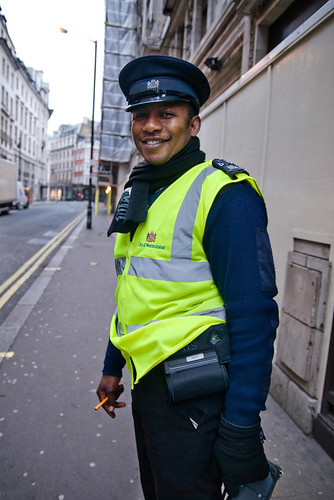
There was little activity in the street besides motor traffic around Wharfdale Road, but there were increasing numbers of revellers standing in the street as I passed Simmons and Keystone Crescent opposite the Tesco on the corner of Caledonia Street. There was a row of cars parked along the east side of Caledonian Road, almost to the junction of Pentonville Road, and there were many people in the street in front of the fast food shop and the Burrito place. There seemed to be activity around an event at Scala on the Kings Cross Bridge. In front of the line of parked BMWs and Mercedes saloons, a group of young Asian men with their arms around one another was standing looking quizzically at a tall black Islington parking warden with long curly hair, as she held up her compact digital camera to photograph the line of vehicles. "Bus Lane" she said to them.

from 365 Londoners

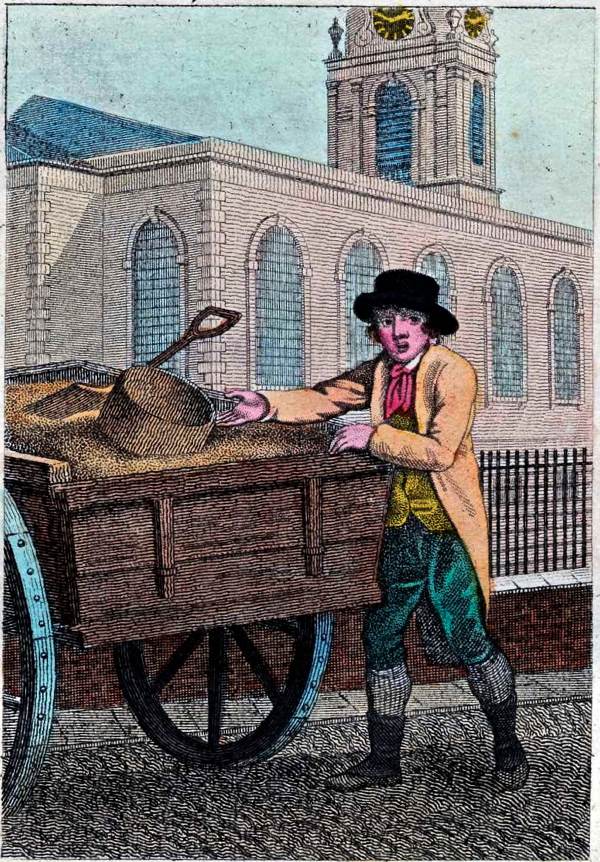
from Wiliam Craig Marshall's 'Itinerant Traders' featured in Spitalfields Life

Sunday, 26 February 2012

Exhibition Road Single surface (draft)

Street London inspection visit to Exhibition Road, a 'single surface scheme'
(Background on new Street Design - Angela Saini on Thinking Streets BBC January 2012)

Research recordings on-site 25 Feb 2012
(recording 120225.000)
[RBKC Highway Engineer]...and that was because of the [CB??] that we put the parking in the centre of the road as opposed to the kerbside as well.
The other thing was that we did reduce a number of the trees in Exhibition Road, and, again, we did actually cut some down, but we replaced more than we cut down, with semi-mature trees as well. All of the eight trees along there were all planted as part of the scheme, they came in from Holland and...
Traffic noise / about scooter / motorcycle parks (Question by Amanda UDG)
There aren't any on Exhibition Rd but there are some down in South Kensington
..and there's no cycle parks up this end...?
No, you are right and yes, that is something that we are reconsidering, actually..
Sorry!
Thats alright..
There is a huge number of resident car parks here with no cars on them - have you got an opportunity to re-visit that assessment and perhaps take some of them out? 
Absolutely, yes, that's right.
And maybe put in more trees?
Trees are a little bit tricky actually, you've got services, and we've also got the tunnel and that sort of thing.
But, yes we are in a sort of assessment period, we only finished the scheme in October last year. So we'll wait and see how it beds in.
As I said before, vehicle speeds are a little higher than we'd ike especially on the section and particulaly in the evening as well. So we migfht have to come back and tweak to do that - maybe just enforcement..
and also some of the turning bans of the A4 are being ignored as well, so we have to look at that.
So the other thing is we are getting requests for more benches down the south section as well - coming out of the Tube station you've got nowhere to sit. There's a bit of resistance from residents there though, because they tend to attract undesirables as well...

1'55" author in informal discussion with Q*
[Practicing urban designer working at an architecture firm in London who studied at University of Queensland, Brisbane]
"We don't really do benches any more, do we?"
 5'11''
Single surface is designed so pedestrians can cross but not walk up and down the carriageway
5'30"
People seems to be doing the same speed
5'55"
How do people know where to park and where not to, here? For example, is that guy there doing the right or wrong thing?

(recording 120225.001)
...background in planning or architecture? Architecture actually...
2'59"
There's no signage here saying no left turn.
[Engineer]
Back there at the traffic lights there is, no left turn on the actual traffic signals there. We are looking at getting some road markings put in and possibly even building up the kerb..
Is that what all that temporary stuff is for? (cnr Cromwell & Exhib Road)
Yes, its taking a while for people to get used to it.
3'20"
This also marks the point where the character of the road changes - from this point north its more to do with museums - from this point south you've got lots of cafes and restaurants and shops. We are in the process of issuing tables and chairs licences to allow people to use the space in a better way kind of thing.
These things you see here sticking out of the road, they are called lanterns, and what they do is provide natural light to the tunnel, pedestrian tunnel underneath, and as part of the first stage of the scheme we actually removed them and refurbished the. They actually fell apart - they have been there since 1850, so it took a while to refurbish them.
Also the street lighting's changed here its more in proportion with the scale of the buildings and that sort of thing as opposed to these big masts
... they were expensive, they were £23000 each those lamp columns and the foundation is a huge great block of concrete, which was the first operation we did, to make sure they were all in line
As big as a tree root-bulb?
Bigger than that, they are about 2metres by 2metres, and we had to allow services to go through them.
5'22"
Basements were the biggest challenge on this job
if you go anywhere near them they start leaking water, then you've got disputes with the owners...
6'05"
Are the lights on all night?
Yes I believe they are.
Projectors cast light on the whole width of the road
So it is a shared lighting scheme?
It is.
7'07"
We've only got minimal road markings
[Amanda UDG]
The banding seems to encourage (motorists to turn diagonally)

(recording 120225.002)
We are on the corner of Exhibition centre opposite the Ismaili Centre, Cromwell Road
[Engineer]
Well I tell you on the funding side of things
Kensington and Chealsea 13 million pounds
Mayor of London 14 million
Westminster 1 million
so they (Westminster) didn't put much money in at all
for some reason they insisted on a more conventional layout (north of Prince Consort Road)
Its more residential and
It could have been a square
Its a political thing
The residents don't any other users to come up
Is that because of litter?
They pay 2 million pounds a bedroom
The residents don't want the great unwashed hanging around
2'06"
[Engineer]
Forty percent of the road is in Westminster, actually, that's from Imperial College Road
So they did agree to this layout on part of the road...

(recording 120223.003)
[Engineer]
The York Stone is all recycled that you currently are standing on at the moment,
Again, before we did the work, there was guardrail running all over the place, lots of traffic lines, all that sort of thing, making it difficult for pedestrians to move around. Now we have taken all the guard railing out, we have got a straight across crossing. We have used york stone here, but we are getting people parking on it, which is why its a bit cracked in some places.
In conclusion, the borough policy is trying to use wherever possible high quality materials and reducing street clutter.
Thank you (applause)
We are Street London, the young Urban Design Network and the Urban Design Group
More tours coming up...

Click on picture below for Street Design photos including Exhibition Road

78 Caledonian Road

On a recent foray I had noticed a new barbershop at 78 Caledonian Road, opposite the Vegan shop (73) and a few doors north of the Mosque (70). Returning from grocery shopping in Islington, I stopped in to try it. A man was having his hair cut, and he and the barber were talking a language I could not recognise, and in which neither of the men seemed fully fluent. The barber seemed to work slowly and very carefully and the customer seemed very particular about his £4.99 cut, also after leaving the chair, standing at a mirror studying all the details of his haircut.


c.2008 (Google Streetview accessed 26 Feb 2012)

The shop had been open two weeks and the sign on the shopfront still said internet cafe - the letting agent's signboard was also still attached above the shopfront. In the window were some flyers advertising introductory offers, and there was a new-looking but inexpensively built set of three workstations with cabinets and mirrors. The packaging for three types of electric hairclippers were displayed on a high shelf alongside some computer-printed photographs of men modelling their haircuts, from the conservative businessman to the sculpted 'Turkish' style to the Anglo-student.

The barber Rajesh* explained in basic English that he was Nepali from Kathmandu, and had established this shop over the last fortnight with daily opening hours of 10.30am - 8pm. He explained that the previous customer was a Bengali with whom he had been speaking Urdu. The barber was a Hindi, the other man a Muslim, who appeared to me to have been testing the barber's abilities. I found Rajesh to be thorough and skilled. He enquired about my background and family and he explained that he had been living in East London for two years, while his wife and son were in Kathmandu.

There was a regular passing footfall on the pavement outside and occasional glances through the glass shopfront on this sunny Saturday. Outside the shop was a sandwichboard stand with four colour A4 flyers advertising the shop. I promised to mention the shop to friends and neighbours.


70 Caledonian Rd. c. August 2008 (Google Streetview accessed 26 Feb 2012)

Tuesday, 7 February 2012

Shop in Niddastrasse - Frankfurt, Railway Station Area


What do you like and dislike about this street – Niddastrasse?  Is it a nice street or not a nice street?
It is a nice street.
Why?  What do you like about it?  The sound, the plants, the people, the buildings ...
No, the people.
What sort of people do you meet in the street, in Niddastrasse?
Ah, the people is very nice behaviour.  I don’t like this fighting or disturb or anything.
Could you tell me a little bit about your shop?  Why is this shop here, what is this shop and what are you selling?
This shop, Coca Cola, Fanta, beer.
What hours of business do you keep?  What time is your shop open?
In the evening.
What hours?
This first my brother is open.  I’m not working here.  This is brother of shop.  I for helping of my brother.  If my brother is weaken or sickness, I come here.  This is my brother is calling and Simon come here and help one hour, two hours I help him.
How late do you keep your shop open?
Ah, the people come from 7 up to 12 o’clock.
12 o’clock at night, ok.  And every day of the week?
Weekness.
Only weekdays.
Yes, from Friday up to Sunday is good.  From Monday up to Friday is quiet.  Not too much people selling.
What kind of people come to your shop?
Everybody. 
Do you find it is many different cultures of people coming here to the shop?
Yes.
Because other people in hotels say that it’s very multi-cultural in this part of the street.  We have Germans, we have Chinese people, we have Ethiopian people, we have Somali people, Turkish people ... do you notice how many from different cultures come here?
Ja, ja.
Is it true?
Ja.
Do people come from hotels nearby as well to come to your shop?  Do they come from the hotels to use your shop?
No.
What about from the train station.  Are there people coming from the train station?
I don’t know from where he coming.  Different people is coming here and they buy something.  I’m not asking from where you coming.
Of course you don’t.
I enjoy with those.  I speaking with those from where do you come mostly speaking English perfect.  If you want something to buy from where you come.  I’m from Russia or from Latin America and we joking.
Are you German yourself?  Do you live in Frankfurt?
Ja,  I am from Frankfurt.
And are you from another place originally?
Ja. Offenbach.
Do you take the train to come here?
Ja.
Finally, is there anything you would like to see improved with this street?  Anything you would like to see more on this street?  Lighting, greenery, parking, more people, different kinds of things ... anything you could see improved with this street?
If I improved this street, this street is good.  I see more people, different people and I know from those peoples, I know many language and I know many ?? conduct from other people from this person from one person to another person.  One person is good mentality or other is ??
You’re happy with this street as it is?
Ja, I’m very happy.
Thank you so much for helping.

Sunday, 5 February 2012

Snow Sunday

After the snowfall on the Saturday night of 4 February, I was out clearing some of the snow from the pavements in my neighbourhood in King's Cross on Sunday.

"Its treacherous here", said one passing neighbour in my council estate, a woman probably in her fifties. "If it freezes overnight, it will be icy here. The council are useless here aren't they?  Why haven't the cleared the snow?" I said that I had got a snow shovel from the council a couple of months ago just in case of this eventuality on a weekend. "I have been here forty five years" she said. I keep buying lottery tickets, as soon as I can get out of here I will. I did my own kitchen and bathroom a few years ago, with checked pink and white tiles, in the Laura Ashley style that was all the rage then. The council came along later and insisted on tearing it all out to redo the bathroom and kitchen. I said no. My husband died some years ago, and I have stayed here."

Another, more elderly man came out to say he was just staying put in his flat for the Sunday during the snow. "How can people go and visit friends? Why not put it off a week, all that motorway driving with the snow on the roads?" Later, the first woman returned, and the man explained I was not from the council. "You would know how it is here Mick, you've been here about thirty years, not quite as long as me. I could have let out my flat to a hundred and fifty Bangladeshis, on their benefits, you know how they are."

A group of young girls was playing and making a snowman in the estate playground opposite. "Look at the (Bangladeshi) kids playing, they have probably never seen snow before. Well, they've got nothing else to do."

Later, in Argyle Street, two young (Bangladeshi) girls approached, "Can we help you?"
"Here you are, do this section up to the tree."

I went to the coffee shop, snow shovel in hand, and seeing the icy pavements along Pentonville Road, I popped around the corner to look at my study patch, Caledonian Road. I spontaneously but casually decided to clear pavements in front of a couple of favourite shops, Housmann's and Drink Shop and Do. I continued clearing past IPB Postbox while I was there, but the pavements outside the pub on the corner had already been done. I noticed the pavement in front of Tesco across Caledonia Street had not been cleared, nor the south-east side of Caledonian Road in front of Leo's Deli, which being Sunday, was closed.

As I crossed over King's Cross Bridge, I thought better of clearing the pavement there, but passing by Subway on the corner, and having cleared some of the pavement opposite beyond the hire bikes on the south side of St. Chads Street, I did clear a walkable path along the pavement on the north side, in front of Comfort Hotel. Later I found a friendly Polish contractor (working for Camden council on a Sunday casual contract until 9pm) in Birkenhead Street who was willing to come and grit in my council block. "In my country, its minus 30 now, everybody does this themselves."

Thursday, 2 February 2012

Congested Streets

What is congestion, in the UK, and in London?

The London Assembly's Transport Committee defines congestion with some difficulty in its recent report, "The future of road congestion in London" (June 2011) and relates congestion to journey time reliability, and the mayor's strategy for  "Smoothing traffic flow" (mainly, it seems, for commercial or motorised traffic).

"The traditional measure of congestion, traffic speed, is problematic when used in isolation. This is because it fails to take into account the way road space is allocated or that average speed can mask unpredictable changes in the flow of traffic. Increasingly, TfL is placing an emphasis on journey time reliability as an important measure of congestion." (pp12-13) This London Assembly report claims to address "all road users" in London, but seems to be concerned mainly with motorised road users, taking traffic to mean motor traffic. The ubiquitous SCOOT junction control systems do not even take into account pedestrians or cyclists at all.

The House of Commons Transport Committee, in a report applicable nationwide, "Out of the jam, reducing congestion on our roads" (15 Sep 2011) includes pedestrian congestion in town centres, as well as congestion on A Roads and on Motorways "like the M25" within its scope. Transport for London's Head of Streets, Garrett Emmerson actually cited "pedestrians disobeying traffic signals" in the report as a cause of road congestion (p7), implying that pedestrians are not part of the traffic flow, but in opposition, even on streets in London.

A website has recently been launched to help travellers in London to predict increased congestion and journey times during the Olympics Games this year. In all of the work on road congestion (as it is called, rather than street congestion) it is interesting that non-motorised traffic on public highways, including cyclists and pedestrians on footways, is not captured statistically nor regarded as significant for balancing road users in a hierarchy. The hierarchy of users on streets (MfS) ought to be very topical in the current debate about streets in London, especially for non- motorised users.

Germany: Verhehrsstau
Verkehrsexperten unterscheiden zwischen „Stau” und „stockendem Verkehr”. In der Schweiz beispielsweise wird „fachlich“ von einem Stau gesprochen, wenn der Verkehr mindestens für eine Minute mit weniger als 10 km/h fließt. Liegt die Geschwindigkeit im Bereich zwischen 10 und 30 km/h, spricht man von stockendem Verkehr.

Friday, 20 January 2012

Bahnhofsviertel Frankfurt January 2012 (Interviews and recordings)

Field recordings
  1. F5 Niddastrasse 49 on 12 Jan 12 @ 1700
    Interview with minister, Loewe von Judah Gemeinde Lion of Judah Church
  2. F6 Niddastrasse 54 on 12 Jan 12 @ 2100
    Interview with barman, Kafe Luna Park
  3. F7 Stadplanungsamt - City Planning Department on 13 Jan 12 @1000 Desk based interview with Stadtplanungsamt Informationsstelle - City Planning Information Service
  4. F8 Niddastrasse 82 on 13 Jan 12
    Field Sound Recording, Italian Restaurant Pizzeria 7 Bello
  5. F8 Niddastrasse on 13 Jan 12 @1200
    end-to-end walking interview with two architects who work in Schleusenstrasse
  6. F8 Niddastrasse 54 on 13 Jan 12 @1300
    interview with (another) barman, Cafe Luna Park
  7. F9 Moselstrasse 6a, on 13 Jan 12 @1400
    Desk based interview with Stadtteilbuero Bahnhofsviertel - Train Station Quarter District Office
  8. F12 Niddastrasse cnr Ottostrasse 13 on 14 Jan 12 @1700 interview with receptionist, Columbus Hotel 
  9. F13 Niddastrasse 39-41 on 14 Jan 12 @2200
    interview with receptionist, Chinese Conference Hotel 
  10. F14 Niddastrasse 58 on 15 Jan 12 @1945
    interview with receptionist, 25h Hotel by Levis Hotel
  11. F15 Niddastrasse 63 on 15 Jan 12 @2100
    interview with tenant, designer at a Graphic Design and Communications Studio
  12. F16 Niddastrasse 84 on 15 Jan 12 @2200
    interview with shop assistant, street kiosk
  13. F17 Stadplanungsamt - City Planning Department on 16 Jan 12 @1500
    Desk based interview with Stadtplanungsamt Abt. Bahnhofsviertel Staderneuerung  - City Planning Department for Bahnhofsviertel Train Station Quarter City Regeneration
  14. F18 Niddastrasse 54 on 16 Jan 12 @1700
    interview with an older lady, at Cafe Luna Park, who had held a birthday party in the street 
  15. Liebfrauenkirche Church Frankfurt on 16 Jan 12 @2100
    Field Sound Recording of Church bells
  16. F19 FH Frankfurt University of Applied Sciences, Frankfurt on 17 Jan 12 @1030 Desk based interview, Dean of Architecture and City Planning 
  17. F20 Niddastrasse 52  on 17 Jan 12 @1200
    interview with waiter, Mian Chinese Restaurant  
  18. F21 Niddastrasse 1-110 on 29 Feb 2012

Moselstrasse, Bahnhofsviertel

A man was walking along Taunusstrasse, one of the Boulevardes in the Station Quarter, on a Tuesday at about about nine in the evening. He had earlier joined a friend at an event at the Schauspielhaus, with the 93 year old feminist psychoanalyst Margarete Mitchalek in interview. A young architect friend had joined the two of them at the square there, near the Occupy Frankfurt camp, beneath the giant Euro sign. They had stopped for a snack at the MacDonalds in Tausstrasse, and while eating, he had noticed among the customers a woman pacing back and forth slightly too close. She seemed intoxicated, he thought, or using drugs, and he gathered from her dress, smell, appearance and behaviour, that she might one of the local sex workers.

He had visited Frankfurt a number of times for research in this extremely diverse inner city area, where he had studied the streets in detail. It was on the final day of an intensive field research visit in the area, looking at urban design and street design, and conducting many hours of detailed interviews about the area, and seeing junkies, red-light tourists, shopkeepers, business people and creatives in the street, building on his understanding of the area's diversity. His friends, a local guide working at a university and a young architect in a Frankfurt office, had agreed to accompany him to visit Pik Dame, a famous old cabaret club in Bahnhofsviertel, as part of his night life research. He remembered passing by the oft-photographed Pik Dame club on a few occasions before, but had not written down the exact address, thinking the place was either in Moselstrase or Elbestrasse, two smaller streets perpendicular to the main boulevardes. These smaller perpendicular streets were lined with clubs, cafes and the famous sex shops, brothels, hourly hotels and other ambigous red-light establishments.

He suggested briefly locating the club while his two friends were at a cash machine on the corner of Taunustrasse and Moselstrasse, and he walked northwards along the west side pavement of Moselstrasse. Soon, a spruiker standing in front of a club approached to recommend and welcome him into the club. Two ladies with the spruiker asked him to come in and enjoy the club, one a large lady dressed in black like a dominatrix. Declining to enter, he said thanks, he had an appointment. Asking the spruiker "Wo ist der klub, Pik Dame", came the jocular reply "Da sind Sie richtig, hier sind Sie".

The man crossed the street, passing a few other mostly male revellers alone and in groups and parked and double parked cars in the street to continue his search on the east side going south. Soon he asked another spruiker for directions and he was approached by an attractive young woman. Come inside for a drink, she said. He looked at her, as she kept him talking, and she seemed sober, clean, well-dressed and well groomed, with only a hint of an eastern European accent. Could she be a trafficked sex worker, he thought? Her long hair was carefully kept, and her eyes were decorated very subtly with contact lenses and/or glistening eyedrops, it seemed. Her makeup was almost unnoticably subtle, and she seemed no younger than twenty-five. "Please just have a look at our club out of interest"  she said, politely leading him by the arm through the curtains. He looked around in trepidation at the interior, which was red and velvety, but more tasteful than expected. The video screen on the wall was playing MTV, not porn as he had feared. They were apparently alone. She guided him to a bar stool and said "Nimm platz, ich lade Dich auf ein bierchen ein. Spater gehen wir oben und..." He hesitated, and said he had an appointment to meet his friends. She reassured him, "Bitte, du bist eingeladen..."

Friday, 6 January 2012

King's Cross Square

Network Rail, September 2011
The hard-won revised public realm scheme by Stanton Williams for one of London's most prominent squares is a great improvement on the previous proposals. However, it is completely segregated from the adjoining public realm on Pancras Way and Euston Road, two high streets with important public realm functions in this transport hub area, which will also be fundamental to the civic, architectural, public realm quality of King's Cross town centre.

On the BBC this week, presenter Angela Saini showed how a holistically considered civic street like Exhibition Road might make for a better, safer urban environment, and a 'happier' place. Her review of current thinking on street design in Europe reinforced the importance of interaction between street users and increasing their 'human sensibilities'. Interestingly, it echoed some of William Holly Whyte's 1975 work, The Street Life Project, which was shown at the Urban Design Group this week.

Euston Road, a 'TFL red route', is a public highway for pedestrians and vehicles, and is an urban street with important public realm functions - extending from the line of bollards at the bus stands, across footway, 'carriageway', barrier and more 'carriageway' to more footway, fronting buildings on the south side of Euston Road. This street realm is managed by the Mayor's TfL Transport for London Streets. This square is one of the Mayor's 'Great Spaces' of London, announced in his programme 'Better Streets' (2009) (pdf).

Network Rail's Press Release announces that planning gain of £750,000 is earmarked for Camden to "improve the pedestrian environment along York Way."

Thursday, 5 January 2012

Street Life Project W.H.Whyte c.1975

The film on "The Social Life of Small Urban Spaces" shown at the Urban Design Group this evening suggested, in ways similar to some points made in Wednesday's BBC Thinking Streets programme, that attractive urban spaces depend upon human interaction.

Whether walking or on wheels, preferably self-propelled, people bring urban spaces to life by interacting with places to sit, with street movement, with sunlight, with water, with trees, and with food. Genius.

The street is the river of life running through the city, he says - people come there not to escape, but to partake.

Tuesday, 3 January 2012

Thinking Streets - what about delight?

A 30 minute item on BBC Radio 4 tonight reviewed new science in 'thinking streets' - with the byline "the streets beneath our feet are getting smart". Contrasting with the ecological-political reference of the situationists' cry "beneath the pavement, the beach", the 'smart' street reference was a 'geeky' one. The UCL Pedestrian Accessibility and Movement Environment Laboratory was featured, where the presenter Angela Saini (author of Geek Nation) visited the "world's largest model street" and seemed fascinated with the iris tracking technology mounted to her headset.

Besides Nick Tyler and the UCL's PAMELA Lab, the programme featured the design of newly completed Exhibition Road, although the presenter did not explain the important difference between shared surface and shared space there. Cycling was discussed (LCC going Dutch), and the pioneering Dutch work of Hans Monderman, Hans De Jong, and of UK's Ben Hamilton Baillie on shared space. John Adams' work on risk compensation theory was incorporated as good background context, and Simon Christmas' work on moral models for 'road users' was introduced

A distinction between roads and streets was not made, something I consider significant, given the programme title. Streets in urban areas have a major public realm function, while roads are often designed primarily for movement. This principle, spelled out in the Manual for Streets (2007 and 2010), and reinforced in the London Mayor's 'Better Streets' guide book of 2009, still seems to elude Transport for London in its press releases about its work in central London, on its 'Transport for London Road Network', on 'Mixed Priority Routes', on High Streets and on urban movement arteries. The public realm is overshadowed by 'road' engineering. Engineering design methods for motorised movement on roads still dominate, and the built legacy of postwar highway engineering remains widespread. The sensory architecture and ambiance of streets as public places remain at a disadvantage.

The issues the programme raises about shared space and risk compensation theory were thought provoking for the concept of sharing the public realm, in my view, unlike the science methods used in PAMELA Lab, however important their work on materials testing and accessibility prototyping of tactile surfaces and proprioception analysis certainly is. In the context of Simon Christmas' research on individual and collective moral models people use when occupying the street, a code of behaviour and humanity emerges in spaces, related to the whole environment. The spatial perception of the street is not only a physical and sensory one. Christmas suggests, with the currently topical example that some "some militant cyclists say they don't minding being hated in traffic, so long as they are safe", that safety alone, however, is not enough. Here I concur, that streets - solely by becoming less deadly - will not make for a better public realm, nor be a source of civic pride.

The streets laboratories and roads engineers have 'overlooked' one part of the Vitruvian triad of the conditions of (good) architecture, 'Firmitas, Utilitas, Venustas' (Firmness, Commodity and Delight). Smart streets should be intelligent in a humanistic, social way, by activating humane and social qualities in users, promoting civic consciousness and pride. Technological and engineering methods, however technically 'smart', will struggle to achieve this. As Christmas says, "happy streets" or "lovely streets" would be a more worthy aim - public places where people enjoy their lives being in the city.

from BBC

Thinking Streets
The streets beneath our feet are getting smart. Pavements are melting into the roads and traffic lights are disappearing. Inspired by the work of scientists and engineers in Holland and Japan, this is a revolution in urban design. Part of it is a movement known as 'Shared Space', which promises to dramatically change the way cities look and how we experience them. In Thinking Streets, Angela Saini asks if all these ideas really fulfil the promise of making us all safer, happier and more efficient?
Two years ago, at the heart of London's shopping district, a strange thing happened. The big red buses, white vans and black taxis that usually skimmed pedestrians as they tried to beat the maddeningly slow grid of traffic lights at Oxford Circus, were stone still for thirty seconds. And suddenly every person standing at the junction scrambled into the middle of the road.
In one stroke, life changed for the 90 million people who step through Oxford Circus every year. Not only has it made life easier for those on foot by giving them 70% more space, it's also faster and looks neater. In 2010, the council even claimed that it contributed to a 7% rise in annual sales in the area's shops.

The Oxford Circus diagonal crossing was one of the first steps in a growing movement to change streets in Britain and all over the world. Today, engineers at Imperial College London are helping to overhaul South Kensington's museum district, with pavements being levelled down to the same height as the road and new criss-cross paving patterns designed to calm drivers (the scheme is nearly complete and the result is striking if rather disconcerting). In Portishead, near Bristol, a trial that removed traffic lights from a notoriously congested crossing was such a success there are plans to roll it out across the town. Other schemes already constructed include Brighton's New Road and another in Ashford, Kent. But Shared Space has been labelled 'speed-bump science' by its critics - Jeremy Clarkson among them. True, one of the guiding principles is reducing traffic speed, often with the use of raised brick-paved areas (very long speed-bumps!) but proponents insist Shared Space is a creative and radical solution aimed at improving the experience of all road users. And the benefits go beyond reduced accident rates to a host of socio-economic benefits for the cities, towns and villages choosing to adopt such schemes.

In practical terms, a shared space scheme will involve removing the distinction between streets and pavements. No barriers, few if any road markings, no pedestrian crossings, and little in the way of street signage. The result of this street minimalism is that you enter a shared space very much at your own risk. And this is the key to improving safety, traffic flow and quality of experience. The early roots of this innovative concept lies in the work of the late Dutch traffic engineer, Hans Monderman. A passionate advocate of shared space, Monderman and colleagues started small - more than twenty years ago, converted an intersection in the northern Dutch province of Friesland from a conventional signal-controlled intersection to a brick-paved street, giving equal priority to cars, people and cycles. The idea was that people would use their own minds in navigating the streets, building their own informal traffic rules. Research has shown that these kinds of shared spaces automatically reduced traffic speed to under 20 mph - the threshold at which the chances of being severely injured in a road accident plummets. This highly counterintuitive approach - increasing risk decreases accidents is finding favour (albeit slowly and not without opposition) all over the world.

Today, Monderman's vision can be experienced throughout his Dutch province of Friesland, no where more so than in Drachten, an unassuming town that until recently was famous only for being the home of the Dutch electronics giant Philips. As Angela discovers for herself, Drachten's shared space schemes (and those of its near neighbours) now attracts a regular pilgrimage of engineers and planners, from all parts of the world, eager to experience this new urban vision.

Episode image for Thinking Streets

Wednesday, 14 December 2011

Frankfurt Gestalten

Frankfurt Gestalten
Frankfurt Gestalten seems a useful forum, part of the OKF Open Knowledge Foundation.

A search for Niddastrasse at the time of writing, for example, yielded thirteen results, ranging from parking issues to a mouse- and rat plague in the Ottostrasse, between Niddastrasse and Mainzer Landstrasse.
Ed Gray in his current exhibition at the Crypt of St. Pancras Church seems to have captured King's Cross; the relationship between King's Cross Square (as it currently stands) and the Euston Road (The A501) - minus the median railings which remain opposite the bus stands, and with the colourful range of people using the area. The buildings 1-11 Euston Road in mid-field, currently threatened by a planning application,and the tidy versions of the MacDonalds York Way, the Lighthouse and distant Travelodge Gray's Inn Road complete the scene.

Monday, 28 November 2011

King's Cross Square


Proposed
Left: Stanton Williams Designs for King's Cross Square. Right: Gaylord Investments' recent proposal for the Euston Road side of King's Cross Square


Existing
The importance of King’s Cross as an international gateway has grown over the last decade, and since Terry Farrell's proposal for the Mayor’s Hundred Public Spaces Programme, which suggested a worthy terminus to Euston Road as one of the capital's grand boulevardes, and of course there has been a global financial crisis. Still, there was a doubling the capacity of the underground interchange, and international-calibre designs for the iconic stations. But despite Camden's 'place shaping' efforts, now the disconnected vision (or lack of vision) of this civic space has seen the calibre of civic design descending to the standards of Gaylord Investments and Transport for London.

A future award candidate? Better to return to the 'Great Spaces' plan.

Update 5 January 2012

Camden New Journal "Shattered Dream"
Developer Nigel Bennett (of Metropolis Planning and Design) was said to have had his dream shattered with the recent refusal of planning permission by Camden Council. Bennett cited 'anti-development' 'lobbyists' as interfering with the project which, despite CABE's report, Bennett personally considered to be an exciting contemporary design. He vowed to appeal over the eighteen grounds Camden gave for refusing planning approval.

Can King's Cross Square have good quality design, world standard architecture and positive civic development? Could it be a Great Space?

Friday, 21 October 2011

BesetzteStraße: Gemischte Strassenbenutzung zu jede Tageszeit, am Beispiel der Bahnhofsviertel Frankfurt und London

Zusammenfassung (English version here)
(aufgearbeitet mit hilfe M. Kuglitsch Oktober 2011)

Ziel
Straßen in Innenstädte könnten lebendiger sein, könnten auch eine nachhaltigerer Rolle im öffentlichem Raum spielen, wenn NutzerInnen von Straßenraum (BesetzerInnen der Straßen) und auch die Gestaltung für diversen Nutzungen der Straße zu jeder Tageszeit - besser verstanden waeren. Die Forschung Werden die Qualität von gemischten Straßen in inneren, dichten Stadtbezirken rund um die Uhr untersuchen. Im Vordergrund der Forschung stehen die Erfahrungen der BenützerInnen, Dies sowohl als auch die Vorgehensweise beim Entwurf der Strasse, da zweiteres für verbesserte Qualität in der staedischen Infrastruktur bestimmend ist.
Die Analyse von Praxis und Theorie in Europa - auch Weltweit - dient als Hintergrund für die Untersuchung zweier Beispielsfallen; jeweils an Verkehrsknotenpunkten in Bahnhofsviertel Frankfurt am Main und in Bahnhofsviertel King's Cross London, GB. Diese Beispiele veranschaulichen die dicht besetzten und auch bekämpften Strassenraume und werden als Probeexemplar herangezogen um die Grenzen der Idee eines gemeinsamen öffentlichen Raumes, eines sogenannten Zivilraumes zu erforschen.

Absichten
Beabsichtigt ist die Erhebung von Fallbeispielen, wo Stassenbenutzung und Strassengestaltung anhand betroffener AkteurInnen festgehalten werden.  Durch die Analyse der Veränderungsprozesse sollen neue Informationen über Benutzerperspektiven und Qualität von Strassen dokumentiert werden. Weiters wären Entwurfsvorschläge zu machen, um die benutzergerechte Qualität zu stärken, beispielsweise  Lebensqualität, Sicherheit, Attraktivität. Zuletzt werden Beispiele zur Umgestaltung und Modellierung entworfen, um zu Bewerten, inwiefern die beabsichtigten Verbesserungen (aus Sicht der BenutzerInnen) erreicht werden.

Occupying the Street

Occupying the Street:
Mixed-Use Street Design for all Hours, London and Frankfurt
Train Station Areas
October 2011

Aim of Research
For inner-urban streets to become more liveable, and to perform a more sustainable role in the public realm, requires a better understanding of users, and of the design of spaces for use at all hours of night and day. The research aims to investigate qualities of mixed-use streets in dense urban transport-hub-areas at various times, with respect to both the user experience and the effect of design processes for urban street environments in regeneration. Analysis of European and international practice and theory provides context for investigating case study streets in Frankfurt-Bahnhofsviertel and London-King's Cross. The two examples of densely occupied and contested hub-area streets will be used to test limitations to co-producing streets as shared public realms, and as civic spaces.

Draft Objectives of Research Project
The objectives begin with analysiing street user experience and street design for the case studies. Analysis of processes of change, via nine research method clusters, will inform an appraisal, incorporating user perceptions about street quality. A second objective is to make design proposals for improving desirable qualities identified by users, such as liveability, safety and attractiveness. A third objective is to model and test some limited examples of design interventions, to determine their likely effectiveness in achieving the intended improvements vis-à-vis perceptions of these users.

Reflections on the research at a milestone point. (Transfer Interview and Report)
Four suggestions which arose from the interview were:
1. Research questions (and interview questions) should consider the agency of design and management of streets, and the degree to which management reflects the diversity of street users.
2. Consider how the movement function is addressed as a user requirement in the study.
3. Consider the nature of the research output and its utility.
4. Assessment of ethical issues and personal safety involved in the field work (esp night time, marginalised people.

Eight other issues raised for further consideration during the interview and in the report were;
1. Should analysis be prioritised in order to best shape the ongoing research?
2. The movement function of streets and their role in the wider movement economy should be better addressed in the methodology. A 'rudimentary syntax analysis of urban grain' might be extended to analysing the differences between a highly-managed non-local movement system and the set of local needs.
3. Mainstream Street Design Practice is based largely on normative and technocratic understandings, and explicit investigation into the management regime and its interaction with the local population would be of interest.
4. A positivist design paradigm is implied in the project methodology; survey, analyse, predict and provide. If design is used as a research tool, design methodology and methods of design evaluation must be carefully considered. Also consideration should be given to how design criteria will be established and tested.
5. How will the findings complement existing practice, if not eg. by design outcomes? How would outputs inform future design and management?
6. Psycho-geographic aspects of methods cluster 2 need further explanation.
7. Ethical concerns for working with hard-to-access user groups, working at night in inner cities need to be considered, along with personal safety, and a risk assessment would formalise these.
8. Would practical outputs of the research study leasd to improved practice? If so, who is likely to benefit from or to undertake this type of practice, and will outputs of the study be presented in a form that can inform practice?

Wednesday, 5 October 2011

Cyclist killed by HGV operator in King's Cross on Monday

Min Joo Lee, 24 year old fashion student at Central St Martins was killed in front of King's Cross Station on Monday morning. Her fashion design work was featured on the fashion website stile.it in March. The famous school where she studied at Central St Martins has just moved into the Granary Building behind the station.

 Work by Min Joo Lee from stile.it

Min Joo Lee was crushed and killed on her bicycle in a collision with a heavy goods vehicle at the road junction Euston Road / York Way / Gray's Inn Road / Pentonville Road, part of London's Inner Ring Road  A501 and an integral part of the infamous King's Cross 'gyratory'. In 2007 in Camley Street, also very nearby the new CSM campus, artist Emma Foa (56) was killed by a turning lorry, crushing her against railings. The driver who killed Foa had been looking for some paperwork in his truck, and was fined £300 for his "inadvertence", but allowed to keep his driving licence.

I was appalled in April 2010 when the 25 year old artist, photographer, graphic designer and music-video director Jane Helliwell was crushed to death by the driver of the 390 bus on Oxford Street. In April 2009, Meryem Ozekman, 37, a fitness instructor and experienced cyclist, was crushed by a lorry driving on the Elephant and Castle roundabout. I was horrified the following day, when 29-year-old architect Rebecca Goosen was crushed to death as the driver of a 32-tonne cement mixer turned left into Goswell Road from Old Street, in Clerkenwell. A pattern of cyclist deaths caused by heavy goods vehicle drivers is clearly continuing.

Rhiannon Williams reported in the Islington Gazette that a spokesman for Transport for London had said of Monday's event: “We are extremely sorry to hear of the death of the woman following a collision with a HGV in Euston Road. More needs to be done to prevent serious harm befalling London’s cyclists, and TfL is working with other organisations across London to tackle this serious safety issue.” The TfL spokesman said that it was the 13th cycle death in London in 2011 compared to 10 last year. There is an ongoing debate (and hopefully increasing awareness) about cycles and heavy goods vehicles sharing the road, and personally, I am increasingly wary of approaching anywhere near these vehicles especially when moving near junctions.

The road should be safer for women and men of all ages and driving abilities, whether experienced or not. However the managers of the street and everyone who uses streets, whichever form of movement they use, need to be responsible for this safety, and this doesn't seem to be currently adequate to reassure us of safety in King's Cross.


Charlie Lloyd's 2010 bike blog article "Lorry drivers have no more excuses when it comes to cycling blind spots" covers many of the campaigns and issues about HGV-cycle conflict, including the need for drivers of heavy vehicles and cyclists to take greater care. Personally I try to be noticed by all other road users on my bicycle, but if inadvertently I go unnoticed, in the case of a heavy goods driver (like one checking for papers) the results could be deadly. How can we make the inner city streets like this one safer? Who else could be involved in the process? Transport for London? Cyclist and Driver communities? Pedestrian Organisations? Universities like Central St Martins? Local King's Cross Communities? Who should care about people being killed on roads where we live and work?

An Urban 75 discussion thread, 'Cyclist Killed at King's Cross Lighthouse', with a hundred comments at the time of writing, suggests this road death in King's Cross on Monday will raise many more questions yet.

Camden New Journal published this story on 27 October: Cyclist deaths - ‘Ghost bike’ at the deadly junction that killed fashion student Deep Lee .


Cyclists killed in collisions with lorries include:
Min Joo Lee (in King's Cross)
Emma Foa (in King's Cross)
Madelyn Wright (in King's Cross)
Cath Ward (in Stratford Upon Avon)
Jayne Helliwell (in Oxford Street)
Rebecca Goossen (in Clerkenwell)
Meryam  Ozekman (in Elephant and Castle)
Daniel Cox (in Dalston)
Catriona Patel (in Oval)
Craig Newton (in Edinburgh)
Naoko (in Hammersmith)

Occupying Streets on fb